A stable gel emulsion skincare formula is built by combining an emulsion with a gel network: you pick a thickening or gelling agent that holds the oil phase inside a continuous aqueous gel, neutralize it correctly, then control electrolytes, cationic compatibility and stability testing. Get those steps right and you get a light, fast-absorbing product; skip them and you get weeping, separation or drifting viscosity.
What is a gel emulsion, and why would a brand want one?
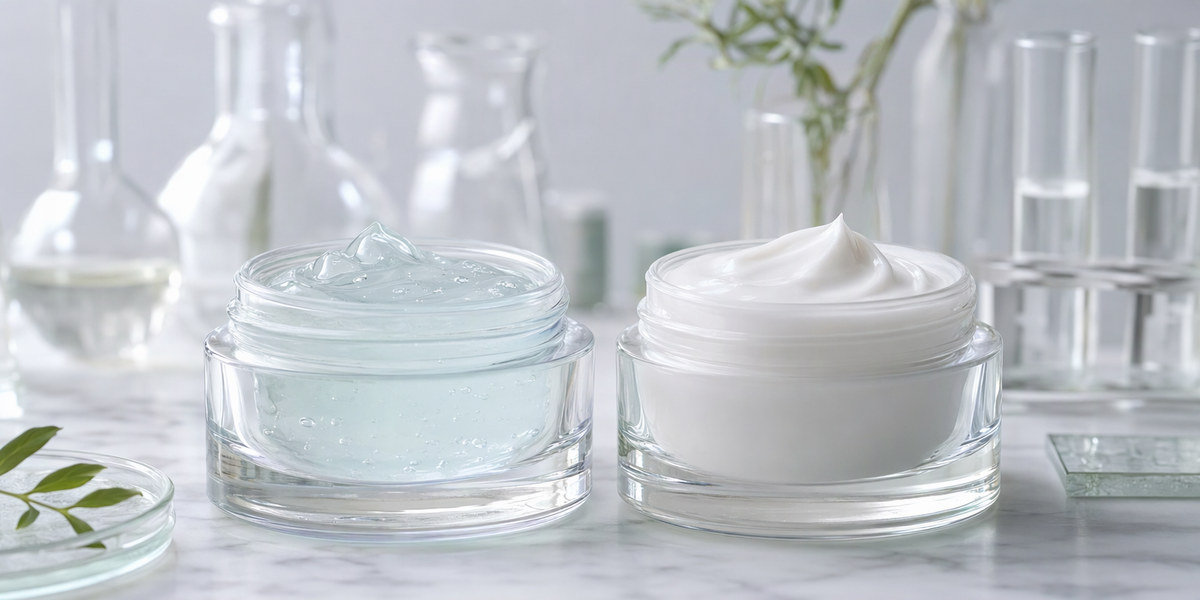
A gel emulsion (often called an emulgel) is a hybrid format. Structurally it is an emulsion, usually oil-in-water, but the continuous phase is thickened into a gel. The result looks and feels like a gel, yet it still carries an oil phase with oil-soluble actives. That combination is why the format has become a default choice for brands that want a lighter alternative to traditional creams.
The practical upsides are sensory and formulation flexibility. A gel emulsion typically feels less greasy, spreads easily and absorbs quickly, which suits oily or blemish-prone skin and humid climates. Because it keeps a meaningful water phase, it can carry both water-soluble and oil-soluble ingredients in one system. Common uses include light moisturizers, serums, sunscreens, after-sun products and soothing gels.
The format is not automatically the obvious choice over a cream or a waterless product. It works well when the priority is a light, fast-absorbing feel and a water phase that can host both soluble actives; it is a weaker fit when the product needs a rich occlusive film, a very high oil load, or a fully anhydrous base. A practical way to decide is to start from the desired end feel and oil budget, then let the texture drive the system rather than forcing a format first and solving problems later.
Which thickener and emulsifier system should you choose?
The gelling agent decides most of the behavior. Several families are in routine use, and each trades off clarity, electrolyte tolerance and cost:
| Gelling agent | Typical behavior | Watch-outs |
|---|---|---|
| Carbomer and acrylate crosspolymers | High clarity, efficient thickening, smooth gel feel | Sensitive to electrolytes and cationic actives; needs neutralization |
| Xanthan and cellulose gums (e.g. HEC) | Robust, pseudo-plastic, easy to use | Lower clarity, can feel slimy at high use |
| Clays (bentonite, hectorite) and silicates | Matte, sebum-absorbing, good for oily skin | Can reduce clarity and add a powdery note |
| Polymeric emulsifiers | Emulsify and thicken in one step | Less flexible across oil loads |
For emulsification you can either use a polymeric emulsifier that also builds viscosity, or pair a conventional emulsifier (such as glyceryl stearate or polysorbates) with a separate thickener. The oil phase is usually lighter and lower in volume than a cream, built from esters, silicones or light oils rather than heavy occlusives.
Why does carbomer neutralization matter?
Carbomer-based systems reach their full viscosity only after the polymer is neutralized to a near-neutral pH. Under-neutralized gel stays thin and unstable; over-neutralization can create other texture or compatibility issues. The neutralizer is typically triethanolamine, sodium or potassium hydroxide, or arginine, and the order of addition matters: neutralize the aqueous gel phase before you load salt-containing actives or electrolytes that would otherwise collapse the network.

This single step is where many first gel emulsions fail, so it belongs on the critical path of any development plan.
What usually goes wrong with gel emulsions?
Most failures are mechanical, not mysterious. The recurring ones are:
- Syneresis — water or oil weeping to the surface. Often driven by electrolyte sensitivity or a thickener that cannot hold the system across temperature.
- Phase separation — usually an emulsion stability problem, where droplet size or emulsifier load was wrong.
- Viscosity drift — a formula that thins or thickens over its shelf life, frequently tied to pH change or slow polymer relaxation.
- Cationic incompatibility — an anionic thickener meeting a cationic preservative or active salt, causing clouding, precipitation or viscosity loss.
- Misleading "oil-free" claims — a gel can still contain esters or light emollients, so the claim only holds when the formula truly carries no oils or occlusives.
None of these are inherent to the format. They are signs that the thickening choice, neutralization or compatibility screening was not finished before launch.
How do you prove stability before launch?
Stability work for a gel emulsion follows the same logic as other leave-on products, but the gel network deserves extra attention. A practical program includes viscosity and pH measurement, appearance checks, centrifugation, thermal cycling (commonly alternating low and high temperatures), freeze-thaw exposure and both accelerated and real-time studies. The exact duration depends on the protocol, packaging and intended shelf life rather than a fixed number, so view any timeline as a planning reference.
Packaging compatibility also matters. Some gels interact with certain plastics or metal closures, so the container should be part of the stability set rather than an afterthought.
What should you prepare before talking to a manufacturer?
A useful brief answers a few concrete questions: target viscosity and finish, desired oil load, which actives must be carried (and in which phase), the markets you plan to sell in, and any sensory claims you intend to make. Suppliers can move faster when they receive a specification instead of a vague request for "a gel."
If your goal is a light, water-rich format, a gel emulsion is often a stronger starting point than a cream or a fully waterless product. If you want a richer barrier feel, a different system may serve the positioning better.
We develop and manufacture gel emulsion and other skincare formats through OEM and ODM programs across skincare, personal care and haircare. If you have a target texture and active list, our technical team at CHONGSHENG FUTURE can review the formulation route and stability plan against real production constraints before sampling.