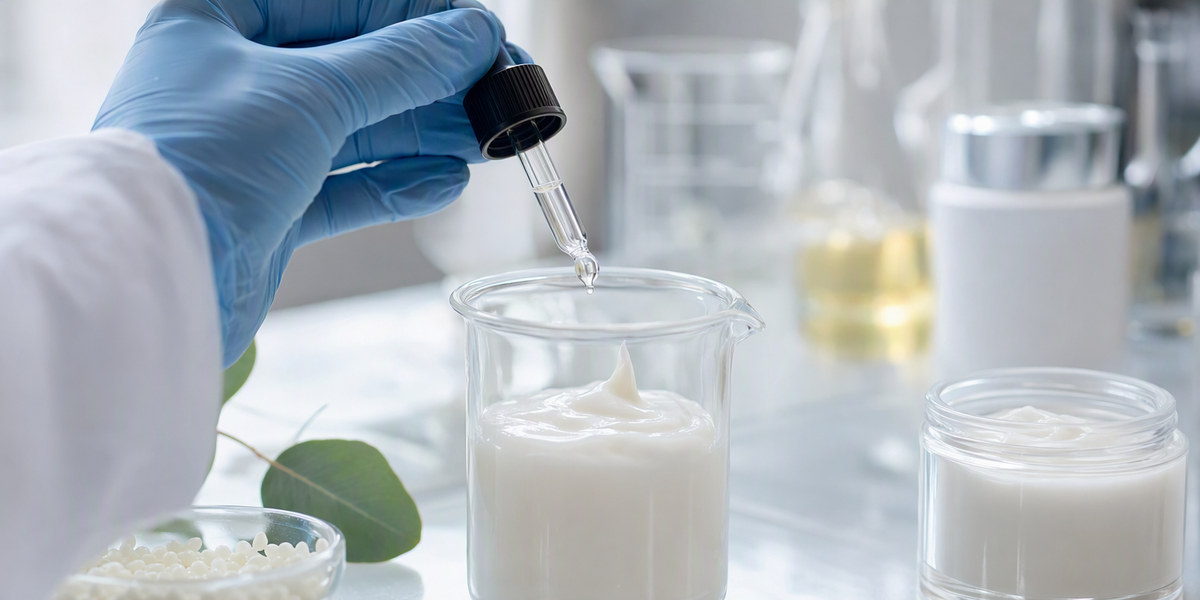
A skincare preservative system is the mix of ingredients and formula conditions that keeps a water-containing product from supporting microbial growth through its shelf life. The right choice depends on how much water your formula holds, its pH, the packaging, and the markets you plan to sell in—not on a single "standard" preservative everyone should use.
Why does a skincare formula need a preservative system?
Most leave-on and rinse-off cosmetics contain water, and water combined with oils, humectants and plant extracts creates an environment where bacteria, yeast and mold can multiply. A preservative system reduces that risk to an acceptable level so the product stays safe and usable through normal opening and daily use.
Anhydrous products—balms, oils and some anhydrous stick formats—often rely on low water activity and sometimes a small amount of a broad-spectrum agent, but they still need a microbial-control plan. "No preservation needed" is a claim that should be supported, not assumed. Shelf life and consumer safety both depend on the plan being real.
Without an effective system, a contaminated product can separate, develop off-odors, or lose performance well before the date on the label. Those are late signs; the microbial load can rise earlier and invisibly, which is why protection is built in from the start rather than added after a problem appears.
What are the main preservative classes used in cosmetics?
Preservatives are rarely a single ingredient. Formulators usually combine agents to broaden the spectrum and lower each individual level. Common classes include:
| Class | Typical examples | What to watch |
|---|---|---|
| Parabens | Methylparaben, ethylparaben | Broad-spectrum; consumer perception varies by market |
| Phenoxyethanol | Phenoxyethanol | Often paired with other agents; concentration limits differ by market |
| Organic acids | Benzoic acid, sorbic acid, levulinic acid | Generally more effective at lower pH |
| Alcohol-based | Benzyl alcohol, caprylyl glycol | Often used in milder or multifunctional systems |
| Isothiazolinones | MIT, CMIT | Effective but linked to sensitization; restricted in leave-on in some markets |
| Formaldehyde releasers | DMDM hydantoin, imidazolidinyl urea | Effective; label and market limits apply |
The table above is a starting map, not a recommendation. Each market sets its own permitted preservatives and maximum levels, so the final selection must be checked against the target markets.
How do you match a preservative system to your formula?
Start with the water content. A formula with high water activity needs a robust, broad-spectrum system, while a low-water or anhydrous formula may need only a supporting agent. Then look at pH: organic-acid preservatives generally perform better in acidic ranges, whereas some agents hold up across a wider pH span.
Packaging matters as well. A jar opened with fingers introduces more contamination risk than a pump or single-dose format, so the preservation burden shifts with the delivery system. A lightweight gel in a pump bottle and a rich cream in a wide jar face different contamination profiles, so the same preservative level that suits one may be light for the other; the formula and the package should be decided together, not separately. Compatibility is a filter that should not be skipped—some preservatives interact with proteins, certain actives, surfactants or emulsifiers, which is why the chosen system should be confirmed in the actual formula, not just on paper.
What does preservative efficacy testing actually confirm?
Preservative efficacy testing, sometimes called a challenge test, exposes the finished formula to a set of challenge microorganisms and measures how the count declines over time. It checks whether the chosen system protects the product under realistic use, rather than whether an ingredient looks right in a datasheet.
Protocols and expectations vary, so view the result as part of your product substantiation and confirm the applicable approach for each market. The test is commonly run alongside stability work, because preservation and stability influence each other. A passing result does not mean the product is sterile; it means the system keeps the microbial count within an acceptable range under the test conditions. Real-world handling is the reason the test uses a deliberately high initial inoculum.
How do preservative rules differ by market?
There is no single global preservative rule. Some markets use a positive list that names permitted preservatives and their maximum concentrations; others rely more on safety substantiation and restricted-substance rules. A preservative that is acceptable and within limit in one market may be restricted or capped differently in another.
For that reason, define your target markets early. The preservative system is not a detail to check at the end—it is part of the regulatory design from the brief stage, and changing it late is more costly than deciding it up front. Document the chosen system and its market basis alongside the formula specification, so the dossier stays consistent when it reaches regulatory review, artwork sign-off and manufacturing handover.
What about "preservative-free" claims?
A "preservative-free" or "free-from" claim can be legitimate when the product genuinely does not contain the named substances and its microbial safety is supported by the formula design, challenge data or both. But the claim must be accurate and should not imply that permitted, safe preservatives are unsafe—claim rules in several markets discourage disparaging lawful ingredients.
If you choose an alternative preservation route such as hurdle technology or a self-preserving concept, document the reasoning. A claim without support is a bigger risk than a conventional system with good data.
If you are building a skincare line and want to pressure-test your formulation brief against real preservation, testing and market constraints, our technical team at CHONGSHENG FUTURE can review the plan with you before sampling.
Related reading
- How Should You Plan Stability and Compatibility Testing With a Contract Manufacturer?
- How Do You Formulate a Waterless Skincare Product?
- How Should You Formulate a Microemulsion in Cosmetics Without Overloading Surfactants?