377 (phenylethyl resorcinol) is a low-dose brightening ingredient, and the formulation questions around it are mostly not about efficacy — they are about a 0.5% China cap, a special-cosmetic registration route, a stability profile that punishes careless processing, and a narrow set of claims you are actually allowed to make. Get those four boxes ticked and 377 is a straightforward raw material to work with; miss one and the product can be pulled off the shelf in China or forced into a relabeling exercise elsewhere. Here is how to approach each one.
What is 377, and how far can you take the mechanism claim?
Phenylethyl resorcinol is sold under trade names such as SymWhite 377 (Symrise). In vitro studies describe it as an inhibitor of tyrosinase, an enzyme involved in the melanin-production pathway. That is the honest limit of what the mechanism evidence gives you: a laboratory-level description of what the molecule does in a test system.
What it does not give you is a finished-product claim. A mechanism studied in vitro says nothing about how much of the effect survives in an emulsion, in a bottle, on skin, over a shelf life. Read the mechanism as the reason the ingredient is worth formulating with, and read your own substantiation package as the reason a claim can go on the pack. Keeping those two separate is the first discipline of working with 377.
What do China’s 0.5% cap and special-cosmetic registration mean in practice?
377 was approved in China through Announcement No. 71 of 2012 issued by the former CFDA, with a safe-use limit of 0.5%. Because 377 is used for brightening, a product containing it cannot be filed as an ordinary cosmetic: it has to go through special-cosmetic registration (the 国妆特字 / 国妆特进字 route). Since December 2021, enforcement has tightened and non-compliant products have been pulled from the market.
For a brand, that changes the project shape in three ways:
- The formula and the claims need to be locked before registration. Registration examines the product as submitted, so late changes to concentration, format or claim wording reopen work you thought was finished.
- Testing is part of the registration file, not an afterthought. The brightening claim needs its own efficacy evaluation, and safety assessment at the intended use level is part of the package.
- The timeline is a registration timeline. Plan around review and testing windows rather than a standard filing, and keep the artwork aligned with the registered wording.
If your product also ships overseas, note that the 0.5% cap is a China number. It is a useful ceiling for formulation discipline everywhere, but it is only legally binding in China.
Why is 377 a stability problem? Light, heat, oxygen and chelators
377 has poor light and heat stability and oxidizes and discolors over time. That makes processing and packaging decisions as important as the formula itself. The standard playbook:
- Add it late. Introduce 377 in the cool-down phase, after the emulsion has formed and the temperature has dropped.
- Keep metal ions out of the picture. Chelating agents bind trace metals that catalyze oxidation; their use is a common formulation practice for oxidation-prone actives, not a regulatory requirement.
- Protect the finished product from light. Opaque or air-restrictive packaging slows the discoloration that a clear bottle on a bathroom shelf will accelerate.
- Validate on the final packaged product. Stability work on bulk tells you very little; what matters is the formula in its intended packaging under its intended storage conditions.
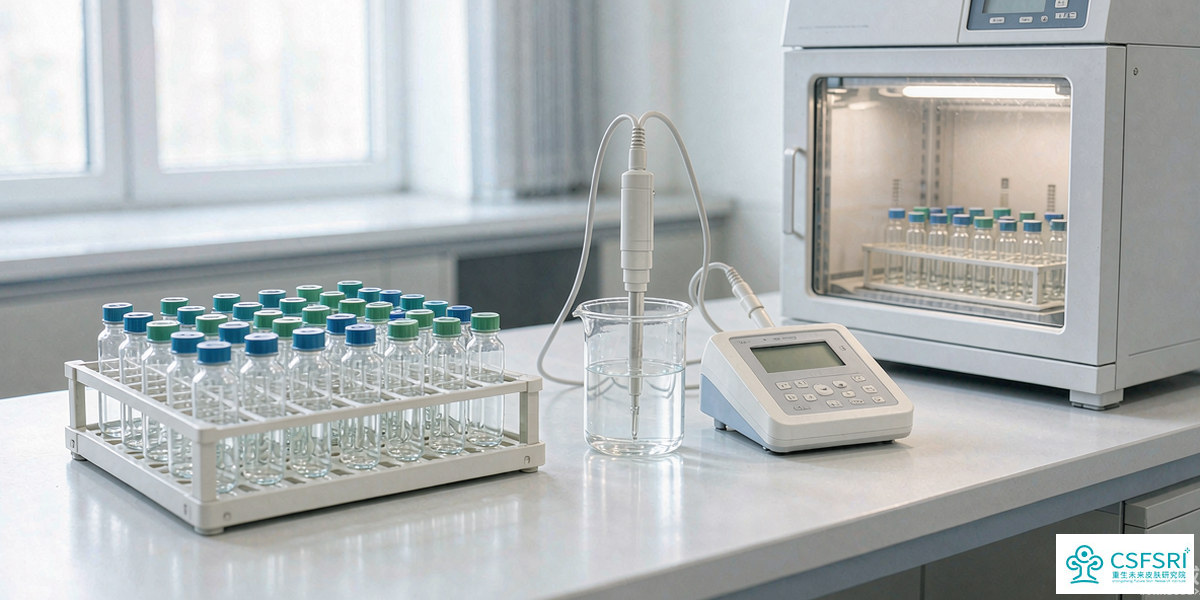
Discoloration is not only a cosmetic issue — a shade shift in a brightening serum is one of the fastest ways to lose consumer trust in the product category, and it is much cheaper to prevent in packaging selection than to explain after launch.
How do you formulate with 377? Dissolution, carriers and pairing
377 is oil-soluble, only slightly soluble in water, and readily soluble in polyols and oils. The practical route is to dissolve it first in a polyol or oil phase, then incorporate that premix into the emulsion at cool-down. Skipping the premix step is a reliable way to end up with recrystallization specks in the bottle.
On concentration: the China ceiling is 0.5%, but the ceiling is not the target. The working level is a formula and substantiation decision — driven by format, the rest of the system and the evidence you hold for the claim. Higher concentrations also carry irritation risk, so chasing the cap is the wrong optimization.
Encapsulation, for example in cationic nanoliposomes, is an active research direction for improving the stability and delivery of oxidation-prone actives. It is a direction worth tracking rather than a standard spec — if a supplier proposes it, ask for the validation data (particle size, encapsulation efficiency, leakage over shelf life) rather than the concept.
Brands commonly pair 377 with other brightening actives — arbutin, tranexamic acid and azelaic acid are frequent companions. Each brings its own concentration limits, stability profile and claim boundaries, and those do not cancel each other out: a multi-active formula inherits the strictest constraint of every component.
How does 377’s regulatory identity differ by market?
| Market | How 377 is treated | What it means for your file |
|---|---|---|
| China | Approved with a 0.5% safe-use limit; brightening use requires special-cosmetic registration | Register before launch; efficacy evaluation for the brightening claim; ordinary filing is not an option |
| EU | No dedicated brightening-ingredient positive list; handled under the general cosmetics framework | No special registration route, but claims still need substantiation under the general claims rules |
| Other markets | Varies by jurisdiction | Check each destination before export; do not carry one market’s conclusion across borders |
The EU position is the one brands most often misread. There is no separate "whitening ingredient" list to get onto, which sounds simpler — but the claim side is where the work moves. Any brightening communication still has to be legal, truthful and evidenced for the finished product. The exact status and claim expectations should be confirmed for your specific destination market before artwork is finalized.
What can you claim — and what is off-limits?
In China, a brightening (祛斑美白) claim requires a human efficacy evaluation under the efficacy-claim evaluation requirements, with a summary of the evidence uploaded to the registration file. Medical terminology, absolute language and any suggestion of "medical whitening" are prohibited. That is the regulatory floor; the commercial ceiling is your substantiation.
| Claim level | Example wording | What it needs |
|---|---|---|
| Appearance / sensory | Helps improve the appearance of uneven tone | Product-level evidence matched to the wording |
| Functional cosmetic | Brightening use consistent with the registered claim | Human efficacy evaluation and uploaded summary in China |
| Off-limits | Medical terminology, absolute superiority, "medical whitening" implications | Not available for a cosmetic, in any market |
One more positioning trap: brightening products are frequently aimed at sensitive skin, and that audience reads labels carefully. If the line also carries a fragrance-free claim, that changes the base-formula and testing work, and neither claim can lean on the other’s evidence. Keep the claim set small, evidenced and market-specific.
What should you ask your manufacturer before locking the formula?
- A dissolution and addition-phase plan for 377 in your specific base, including the cool-down window.
- Stability data on the final packaged product — not bulk — covering appearance, odor and assay over the intended shelf life.
- The oxidation-protection strategy: chelator choice, processing temperature profile and packaging compatibility.
- Irritation and sensitivity data at the intended use level, especially for sensitive-skin positioning.
- Registration support for the China special-cosmetic route, and a claim substantiation package matched to each target market.
If you are planning a brightening product built around 377, our technical team at CHONGSHENG FUTURE(重生未来) can review the formula route, the stability plan and the claim set against your target markets before sampling begins.