Before entering the Japanese skincare market, the three things to get right are the regulatory framework (cosmetics are not pre-approved and the brand carries self-accountability, while certain claims sit in the quasi-drug category), the labeling and ingredient rules, and the sales channels that actually reach Japanese buyers. Align these early and the launch is far less surprising.
How is the Japanese cosmetics framework different?
Japan does not pre-approve general cosmetics before sale. Instead, a responsible party — usually a local entity — holds self-accountability for product safety and labeling. That shifts the compliance burden onto documentation and ongoing vigilance rather than a pre-market gate.
- General cosmetics stay at appearance-level claims and are sold under the responsible-party system.
- Whitening and UV protection typically fall under the quasi-drug (医药部外品 / quasi-drug) category, which follows a separate approval pathway. They are not simply marketed as general cosmetics.
- Overseas brands usually appoint a local responsible entity — a distributor or a local office — to act as the accountable party for import and post-market obligations.
What are the labeling and ingredient rules?
Compliance starts on the package. Japanese buyers and inspectors read the label closely, so the details matter.
- Japanese-language labels are required, with ingredient names, usage, warnings and the responsible party clearly stated.
- Ingredients follow positive standards with concentration limits for certain substances; check the permitted and restricted lists before finalizing the formula.
- Sun protection uses local SPF and PA notation, which differs from EU and US labeling conventions.
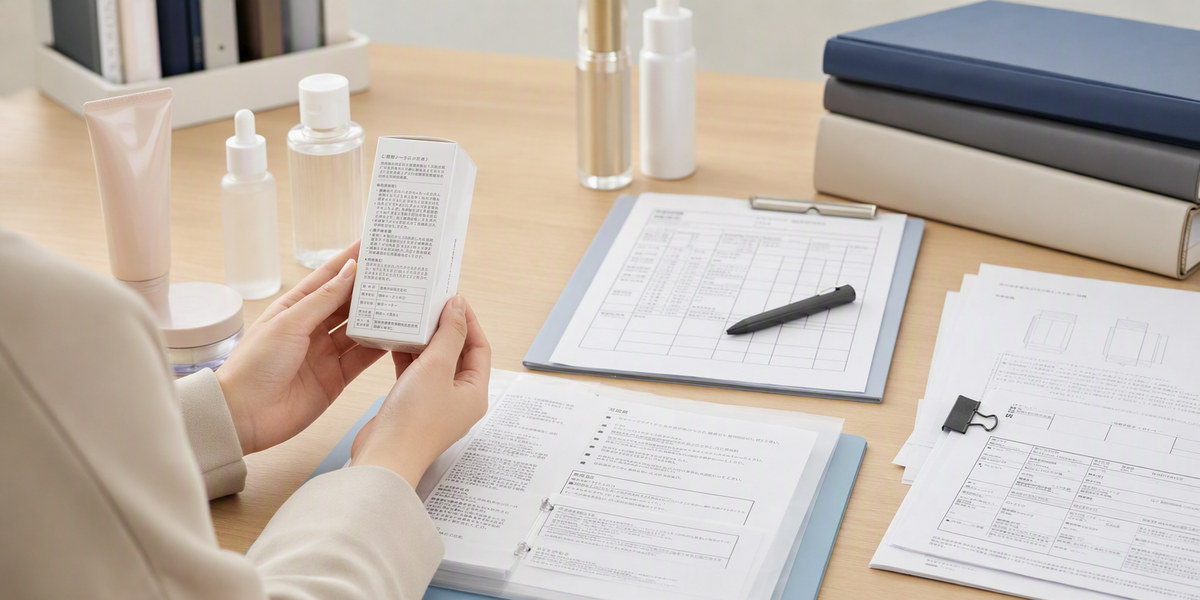
Which claims can you make, and which cross the line?
The claim boundary is where many launches stumble, because it differs from the EU and US framing.
- Safe lane: appearance-level claims — moisturizes, smooths, brightens the look of tone — for general cosmetics.
- Quasi-drug lane: whitening and UV protection need the corresponding approval; do not import a product carrying those claims as a general cosmetic.
- Avoid: medical or therapeutic language. The self-accountability system still expects every claim to be supportable.
For any claim you make, keep the supporting evidence — studies, ingredient rationale, internal test data — organized and ready, because the responsible party may need to show it on request. Japan’s self-accountability model puts the burden of proof on the brand rather than a pre-clearance step.
Which channels actually reach Japanese buyers?
A technically compliant product still needs the right route to shelf and screen.
- Drugstores and pharmacies (the 薬局 / ドラッグストア channel) are the dominant brick-and-mortar route.
- Online marketplaces such as Rakuten and Amazon Japan, plus discovery platforms like @cosme, drive a large share of first-time trial.
- Cross-border e-commerce can test demand, but compliant import and ongoing obligations usually still require a local responsible entity.
Discovery matters more in Japan than in many markets. Platforms like @cosme shape reputation through user reviews, so a launch plan that ignores review-building tends to stall regardless of ad spend.
What do Japanese consumers actually value?
Taste in the market rewards restraint and evidence over loud promises.
- Mildness and low irritation are consistently prioritized, alongside clear efficacy evidence.
- Whitening and UV protection are perennial strong categories, but claims must be backed and framed within the rules above.
- Packaging tends toward restrained, functional design rather than bold claims on the box.
What trips up first-time entrants?
- Assuming a general-cosmetic formula can carry whitening or UV claims without quasi-drug approval.
- Shipping labels that are not fully in Japanese, including warnings and the responsible party.
- Treating the local responsible entity as a formality rather than a compliance partner.
Trial sizes and sample campaigns are a common, low-risk way to build the review base that later drives conversion, which fits the review-led culture above.
If you are planning a Japan launch and want to pressure-test your formula, claims and labeling against the local framework, our team can review the plan with you before you commit to import.