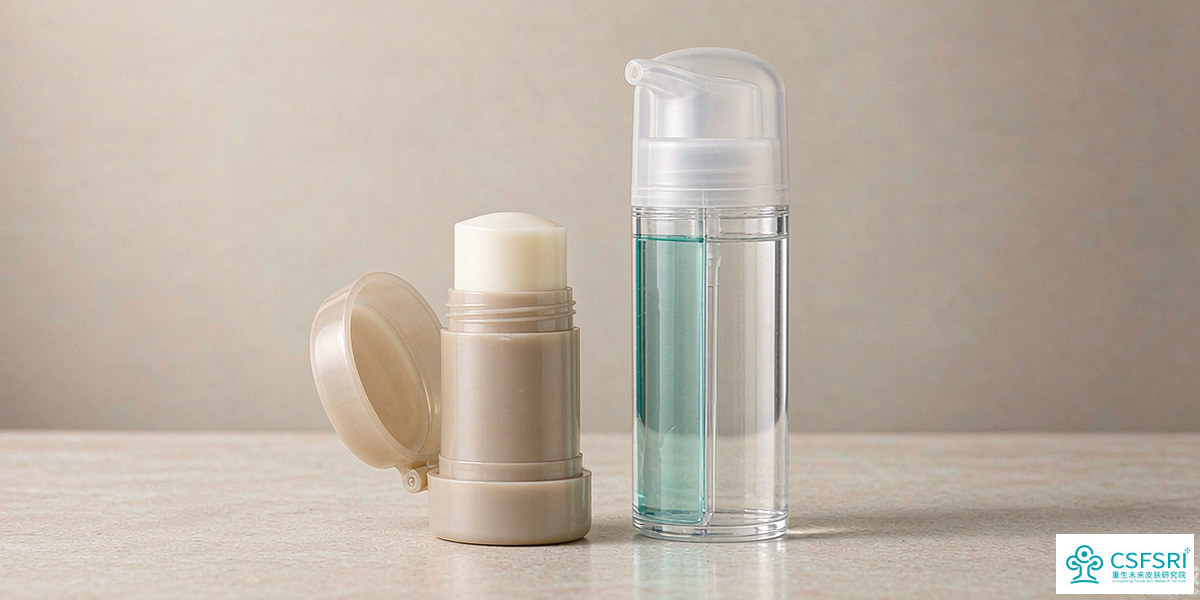
Stick and dual-chamber skincare formats abandon the conventional emulsion. A stick is typically built on an anhydrous or low-water base of waxes, oils and esters, and a dual-chamber pack keeps two formula phases apart until they meet at the valve. That single design choice moves the development workload: less effort goes into emulsion stabilization, and more goes into base behavior, filling control, package tooling and format-specific validation.
What Is the Base Logic Behind Stick Formats?
A cream or lotion is an emulsion: water, oil, an emulsifier and a preservative system working together. A stick usually drops the free water entirely, or keeps it to a minimum. The structure comes from a wax network instead of an emulsifier film, and the formula is typically a blend of:
- Waxes — set the melting point window and the mechanical strength of the stick
- Oils and esters — control spreadability, payoff and skin feel
- Actives, pigments or powders — dispersed in the oil phase rather than the water phase
Removing the water phase changes several things at once. The microbiological risk profile differs from a water-containing emulsion, which changes the preservation strategy — although exact requirements depend on the formulation, the claims and the target market, and should be confirmed case by case rather than assumed. Texture also shifts: slip, melt-down and after-feel now depend almost entirely on the oil and ester selection, because there is no water phase to carry humectants the way a lotion does. A stick is therefore not a "cream in a stick tube" — it is a different product architecture, and the base needs to be designed for the format from the start. Anhydrous stick development follows waterless skincare formulation principles, a discipline with its own rules.
How Do You Control Pouring and Shrinkage?
Sticks are made by pouring, not cold-filling: the base is melted, actives and pigments dispersed, the blend held at a controlled pouring temperature, filled into molds, cooled on a controlled curve and demolded. Each step leaves a fingerprint on the finished stick:
| Process parameter | What it affects | Typical check on the finished stick |
|---|---|---|
| Melting and holding temperature | Wax dissolution, pigment dispersion, trapped air | Surface finish, graininess |
| Pouring temperature | Flow into the mold, cavity fill | Edge definition, voids |
| Cooling rate | Wax crystal structure, shrinkage | Hardness, break strength, surface sweating |
| Demold timing | Mechanical strength at release | Surface damage, deformation |
The common failure modes are all process-sensitive: oil bleeding to the surface (sweating), a grainy or sandy texture from uncontrolled crystallization, dull or mottled surfaces, shrinkage dimples, chipped edges and sticks that snap in the sleeve. The countermeasures come from three levers — wax type and ratio to set the melting window, pour temperature to control flow and cavity fill, and a cooling curve tuned to the base.
Shrinkage is a function of the specific base, the mold and the cooling profile, so quantify it from actual base and packaging data rather than a generic figure. In practice, lock the base, run a small set of designed trials on pour temperature and cooling rate, and use the resulting window as the validated process range.
What Problem Does a Dual-Chamber Pack Solve, and at What Cost?

A dual-chamber (dual-tube or airless two-compartment) pack stores two formula phases in separate compartments and brings them together only at the valve or nozzle, at a designed ratio, at the moment of dispensing. It earns its place when the two phases should not meet earlier — for example, when two actives are unstable in the same phase, when a concentrate is activated at the point of use, or when the formula is mixed fresh on application.
The cost side is real and should be priced into the project from day one:
- Tooling lead time. The chamber body, piston and valve are usually custom-molded, and mold cycles are long — often the item that gates the launch schedule rather than the formula itself
- Filling capability. Two chambers must be filled to controlled levels in sequence, on a line configured for it
- Higher residual. Dual-chamber packs typically leave more product behind, which matters for cost-per-use and shelf-life accounting
- Cost and MOQ. Component complexity lifts unit cost, and custom components usually lift minimum order quantities above standard stock packaging
Packaging development decisions of this kind deserve their own project track, reviewed alongside the formula track rather than after it. This is the same critical-path thinking behind planning a private label skincare line.
How Do You Verify Dispense Ratio and Valve Matching?
The technical heart of a dual-chamber format is the dispense ratio: the proportion of the two phases that actually reaches the user. If the ratio drifts, the product no longer matches the tested formula. Three things drive drift — valve wear over the pack life, viscosity differences between the phases, and fill-level differences between the chambers.
Validation therefore covers more than a single development sample:
| Check | Why it matters | Acceptance basis |
|---|---|---|
| First-shot uniformity (the first actuations) | The first doses are where ratio error is highest | Ratio and mix quality of the first shots, per agreed spec |
| Ratio accuracy across the pack life | Valve and chamber behavior change as the pack empties | Ratio at start, middle and end of pack |
| Actuation force and valve function | User experience and consistent delivery | Force range and complete stroke, per spec |
| Residual and chamber emptying | Cost per use and shelf-life accounting | Residual level agreed with the brand |
One point cannot be shortcut: dispense uniformity is a per-batch verification, not a one-time development study. Filling levels, valve lots and line settings vary between runs, so each production batch needs its own confirmation against the agreed acceptance criteria, with sampling points and pass criteria defined before the first commercial run.
What Matters in Temperature-Resistance and Shelf-Life Studies?
The stability and compatibility testing framework is familiar — temperature exposure, cycling, real-time shelf life — but the check items change with the format. A stick is watched for surface sweating, wax crystallization, softening or deformation at elevated temperature, break strength and changes in color and odor; exposure around 40°C is a common test condition in industry practice, though the exact conditions and duration should follow the product, the target market and the intended shelf life rather than a fixed rule. A dual-chamber pack is watched for ratio drift, valve function after storage, inter-chamber leakage and phase behavior.
Two practical notes: shipping conditions belong in the program, since summer warehouse and transit temperatures are a real risk for anhydrous sticks; and material compatibility with the actual sleeve, piston and valve needs early attention, because oil-rich bases can interact with certain elastomers. The overall protocol should be designed per format and confirmed against base and packaging data; durations and conditions vary by product and market.
When Are These Two Formats Worth the Investment?
A stick format fits when the product benefits from an anhydrous architecture — a low-water or preservation-light design goal, a portable use case, or a differentiated format that stands out on shelf. A dual-chamber pack fits when two phases truly cannot coexist, or when a fresh-mix-on-dispense concept rests on a real technical basis rather than a marketing story.
Knowing when to stay with a conventional pack matters just as much: when the positioning is cost-sensitive and custom packaging would push unit cost beyond what the price point supports; when the launch window is tight and component tooling would sit on the critical path; and when a single-chamber formula delivers the same product story without the added complexity.
Where cost decides, reading an OEM skincare quotation line by line separates component cost from filling and testing cost.
For projects that do proceed, lock the packaging route early: in our experience, custom component tooling is more often the schedule constraint than the formula itself, and formula validation can usually run in parallel once the specification and package direction are set.
Working With a Manufacturing Partner on These Formats
If a stick or dual-chamber format is on your roadmap, bring the manufacturer the intended format, the actives and their stability constraints, the target market and shelf life, and the volume and cost envelope. With those in hand, the technical team can assess the base or valve route, flag tooling implications early and plan the validation program before sampling begins. Share your target format, actives and market with our technical team, and we can assess the formulation and packaging route before the first sample run.