Cosmetic stability and compatibility testing are the checks that tell you whether a formula will still look, feel and perform like the product you approved when it reaches the customer. If you plan these with your contract manufacturer before scale-up, they protect your launch timeline instead of delaying it; the exact program depends on the product format, packaging, claims and target market.
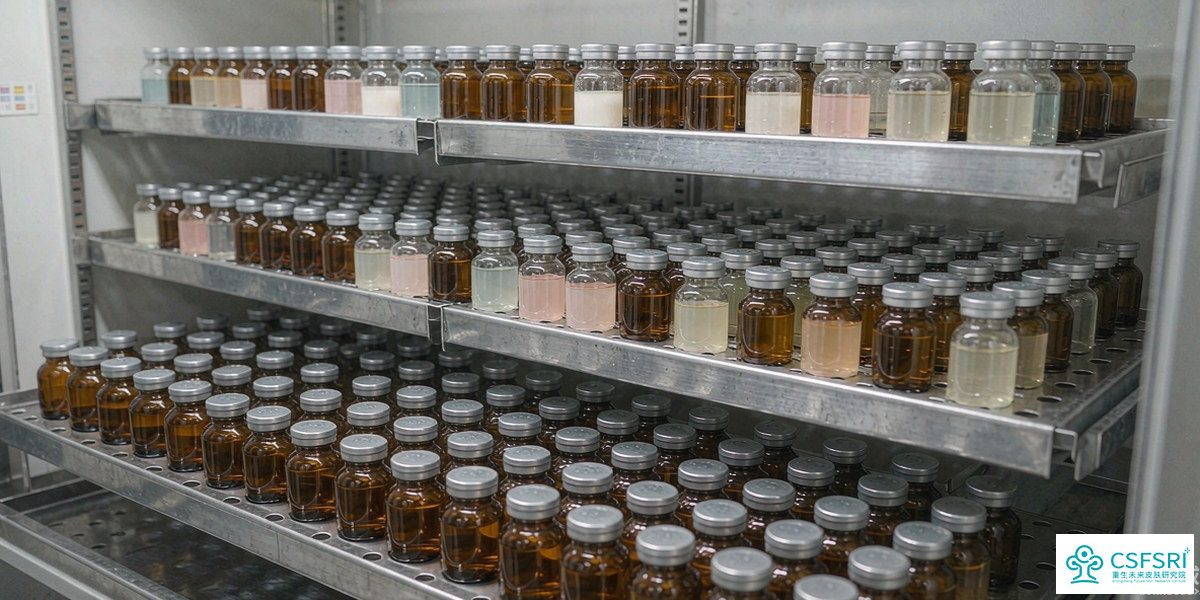
What does a stability program actually check?
A stability program tracks how a product changes under defined conditions over time. Typical readouts include appearance (color, clarity, separation), pH, viscosity, odor, microbial status and, where relevant, active-ingredient content. The goal is to confirm the product holds its quality across its intended shelf life and storage conditions.
It is a technical substantiation step, not a single universal legal gate. The exact expectations vary by market and product type, so handle the protocol as something to confirm for your specific case rather than a fixed rule. For brands making measurable claims, stability data also feed the claim-substantiation file: if you state that a product keeps its active content for 12 months, the stability results are what back that statement.
How long does stability testing take?
There is no single duration. Accelerated studies commonly run at elevated temperature and humidity (often around 40–45°C with controlled humidity) for several weeks to a few months, while real-time studies at ambient conditions run longer. The right length depends on the product, the packaging and how conservative the brand wants to be.
| Approach | What it is | Planning reference |
|---|---|---|
| Accelerated | Stress at high temperature/humidity | Weeks to a few months; indicates likely failure modes faster |
| Real-time | Storage at intended conditions | Longer; supports the actual claimed shelf life |
| On-going | Batches tested after launch | Common for quality monitoring |
Because the testing window sits on the critical path, start it as early as the formula and packaging allow. Waiting until artwork is finished is a frequent cause of avoidable launch delay.
What is compatibility testing, and why does it matter?

Compatibility testing looks at how the formula interacts with the packaging — the bottle, pump, tube or jar. Some materials can absorb actives, leach compounds, or react with the formula, and those effects may only show after weeks. If you lock packaging before checking compatibility, you risk a recall-risk interaction or a changed sensory profile after filling.
The practical rule: qualify the packaging together with the formula, not after. This is especially important for airless systems, droppers, metal components and any component that touches the product directly.
Which other tests usually run alongside?
For water-containing products, preservative efficacy (challenge) testing is commonly part of the picture, because it evaluates whether the preservation system holds back microbial growth. Whether a given test is expected depends on the formulation, preservation system and market — confirm the requirement rather than assuming.
- Microbiological limits testing on the bulk and finished product.
- Claim-support testing (instrumental or consumer-use) when the product makes a measurable claim.
- Transport and thermal-cycling tests for products shipped across climates.
What stability data do you receive, and how do you read it?
After the study, you should receive a report that lists the tested conditions, the time points, the parameters measured and the result at each point. Read it for trends, not just a pass mark: a slow drift in pH or a slight color shift may be acceptable, while separation or microbial growth is not. Agree on the report format early, because some markets expect the data in a specific structure for registration or notification.
If the product is sold across climates, ask whether the protocol included thermal cycling or a high-temperature pull. A formula that is stable at 25°C can still fail in a hot warehouse or a delivery truck in summer, and that risk only shows up if the test was designed to catch it.
What should a brand ask the manufacturer before testing?
A short checklist keeps the program aligned with your launch:
- Which stability protocol do you use, and what are the pass/fail criteria?
- Does the program include packaging compatibility, or is that separate?
- What is the realistic turnaround, and where does it sit on our timeline?
- What report format do we get, and does it support our target-market submission?
- Can challenge and compatibility testing run in parallel with stability to save time?
How do you keep testing from delaying the launch?
The main variables are component lead time and sample preparation, not the chamber itself. Lock the formula and packaging early, place component orders in parallel with the first stability pull, and agree on the report format up front so nothing has to be repeated for a market submission. A common mistake is to leave stability to the final gate; when it runs in parallel with packaging qualification and claim testing, the overall path is shorter even though each study takes the same time.
If you are scoping a new line and want the stability and compatibility plan built into the development timeline rather than bolted on at the end, our technical team can map the testing window against your target markets and launch date.