L-Ascorbic Acid (the pure form of vitamin C) and vitamin C derivatives are not interchangeable. The pure form is more reactive, less stable, and harder to formulate, but it has the shortest path from the bottle to the skin. Derivatives are stable, gentler, easier to work with, and easier to scale, but they need an enzymatic step on or in the skin to convert. The right pick depends on which trade-off matters more for your product: speed of visible results, or consistency across the shelf life.
Below is how we walk B2B clients through the choice, and which form we usually reach for in different product briefs.
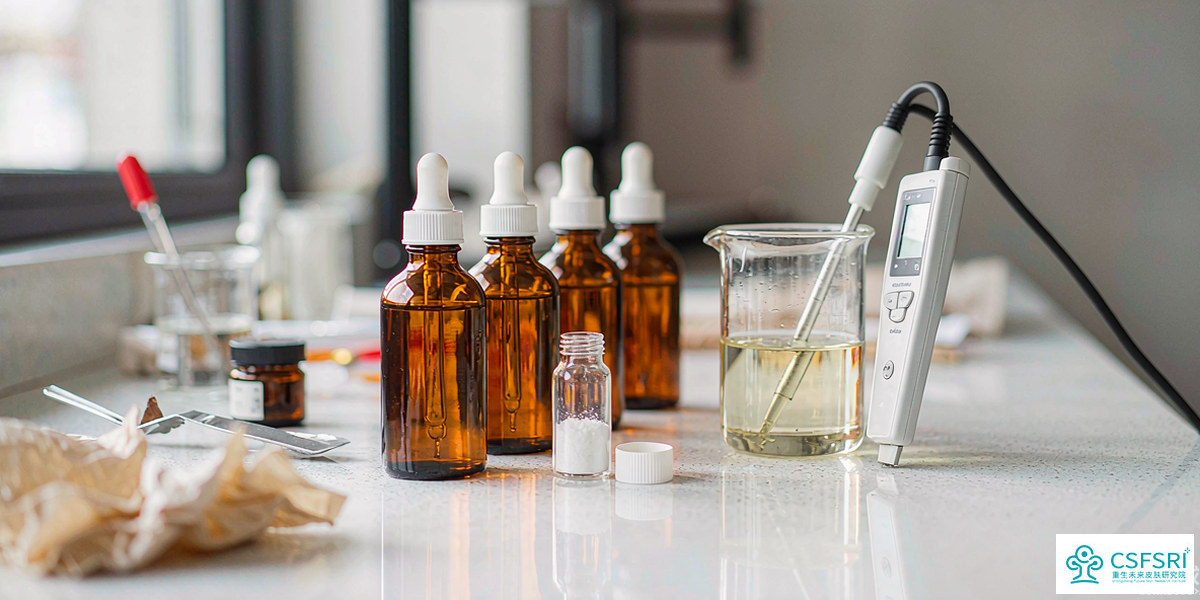
What changes between L-Ascorbic Acid and a derivative?
The molecule behaves differently. L-Ascorbic Acid is the biologically active form, but in a bottle it is also the one that oxidises fastest: water, oxygen, light and heat all drive it to turn yellow-brown. To keep it active, formulators drop the pH into the 3.0 to 3.5 range, often pair it with tocopherol and ferulic acid, and ship it in opaque airless packaging. Done well, it works. Done badly, the serum arrives at the customer already oxidised.
Derivatives attach another chemical group to the ascorbic acid backbone. The attached group makes the molecule water or oil soluble, raises its tolerance to pH and oxygen, and usually softens the irritation profile. The skin’s enzymes then cleave the protecting group, releasing active ascorbic acid in the upper layers. The trade-off is that conversion is not 100 percent and varies between derivatives, so the effective dose in tissue is lower than the dose on the label.
What are the main forms B2B briefs usually compare?
Five forms cover most skincare lines. Each one earns its place in a different brief.
- Sodium Ascorbyl Phosphate (SAP). Water soluble, stable at skin pH, the gentlest of the five. Often used at low single-digit percentages for daily-use brightening products and for acne-prone skin in some markets.
- Magnesium Ascorbyl Phosphate (MAP). Similar profile to SAP. Slightly different feel on the skin, slightly different salt form, sometimes preferred in emulsion bases.
- Ascorbyl Glucoside (AA-2G). Water soluble, very stable in formula, enzymatically cleaved on the skin. Often used at low single-digit percentages.
- Ascorbyl Tetraisopalmitate / Tetrahexyldecyl Ascorbate (VC-IP / THD). Oil soluble, used at low single-digit percentages in oil phases, serums and balm textures. Stable in formula and in some emulsion systems.
- 3-O-Ethyl Ascorbic Acid (EAC). A water-soluble ethylated form. Brightening claims exist at higher percentages, mostly in the 5 to 10 percent range. Compatible with most other actives a brand typically stacks.
L-Ascorbic Acid itself stays in the brief when the brand wants the most direct mechanism on the skin and is willing to manage a low pH, an airless pack, and a shorter shelf life.
How much of each form do you actually need?
There is no universal percentage. The dose on the label and the dose that reaches the skin are two different numbers, and they vary by derivative.
For L-Ascorbic Acid in leave-on serums, the common concentration range sits around 10 to 20 percent. Higher than that, irritation and oxidation tend to outweigh extra benefit. For derivatives, single-digit percentages are normal. SAP and MAP are often used below 5 percent. VC-IP and THD are often used below 2 percent and still feel workmanlike in formula. AA-2G tends to be dosed in the low single digits. EAC is the only derivative that commonly pushes into the 5 to 10 percent range.
The honest framing for a brand: a higher percentage is not automatically a stronger product. Each form has a working window, and going above it usually adds irritation, cost, or formulation headaches without adding efficacy.
How do you keep the formula from going off?
Stability is the part most briefs underestimate. Four factors drive L-Ascorbic Acid breakdown: water, oxygen, light, and heat. Remove any one of these and the formula lasts longer.
Standard moves in industry practice:
- Drop pH into the 3.0 to 3.5 window for L-Ascorbic Acid serums.
- Pair L-Ascorbic Acid with lipid-soluble antioxidants like tocopherol and with ferulic acid, the Duke 2005 combination published by Lin and colleagues and still widely cited.
- Use opaque, airless, or vacuum packaging to limit oxygen ingress during use.
- Add chelators like sodium EDTA to bind trace metals that accelerate oxidation.
- For derivatives, keep pH in the range the supplier specifies, and avoid stacking them with strong acids that can hydrolyse the protecting group.
Derivatives do not have the same oxidation problem, but they are not immune. pH drift in the formula, hydrolysis during long storage, and packaging that lets in oxygen can still degrade them. Treat each form’s supplier stability data as the floor, not the ceiling.
Where does regulation actually draw the line?
Vitamin C is a cosmetic ingredient in the United States, not an OTC drug. That means claims stop at appearance, feel, and general skin support. They do not go into disease language.
In the EU, Regulation (EC) 1223/2009 Annex III lists maximum use concentrations for several vitamin C derivatives, and the numbers differ by derivative and by product type. The Annex is updated periodically. Final concentration for a specific derivative, in a specific product type, on the EU market, has to be checked against the current Annex III before launch.
China’s NMPA (the National Medical Products Administration) treats vitamin C derivatives as cosmetic ingredients under the Safety and Technical Standards for Cosmetics. Concentration limits in those standards have been updated in recent revisions and should be re-verified for the current edition before any China launch.
For Korea, classification depends on the claim wording. Anti-aging and brightening claims often push the product toward Korea’s "functional cosmetic" category, which adds documentation and review time. We have a separate article on the Korea entry path that walks through general versus functional classification and the MFDS review focus.
How do we usually decide on a brief?
The decision tree most clients land on looks like this.
If the priority is direct visible effect and the brand can commit to low pH, opaque airless packaging, and a shorter shelf life, L-Ascorbic Acid at 10 to 15 percent is reasonable. If the priority is a gentle daily-use line that any skin type can pick up without a tolerance build-up, a derivative (SAP, MAP, or AA-2G) at low single-digit percentages is reasonable. If the brief calls for an oil-phase or balm texture, VC-IP / THD is usually the cleaner fit. If the brief asks for a higher percentage derivative with a wider pH window, EAC is the usual second look.
After the form is chosen, the next step is to confirm the dose and claim wording against the regulatory limits in the target market (Annex III for the EU, NMPA’s Safety and Technical Standards for China, and the relevant MFDS guidance for Korea). Then the formula, pack and stability program fall into place around that envelope.
For brands that want help moving from a brief to a lab-scale sample, our OEM team can take it from this decision tree to a first batch and run the stability program alongside it.
Related reading
- Why Would a Skincare Brand Choose an Anhydrous Formulation? (covers oil-phase anhydrous systems that work well with VC-IP)
- How Should a Skincare Brand Formulate With Retinol? Stability, Concentration, and the New EU Limits (a parallel story of an oxidation-prone active and EU concentration caps)